
October 2026 · About 5 minutes
Pulling five openings forward from phase 3 does not cost the shop five openings’ worth of work. It costs the drop.
The release was clean. Phase 1 is the south elevation, phase 2 is the north, phase 3 is the courtyard. The shop built the cut list for phase 1, pulled stock, and nested the cuts so the 24-foot lengths came out with almost nothing left over. Then the GC moved the courtyard entrance up, and the PM asked the shop for openings 301 through 305 this week. Five frames. The shop lead did not say no. He said it would cost two days and a bundle of stock, and the PM did not understand why.
What a phase is to the shop
To the PM, a phase is a set of openings and a date. To the shop, a phase is a cut list, a material order, a machining order, an assembly sequence, a staging area, and a packaging plan, all built together so the material flows once. Define each fabrication phase on the release by the openings in it and the date the field needs it, and the shop plans the whole phase as one run. Change the set after the plan is made, and every one of those things has to be re-planned.
Phasing also decides material optimization. Aluminum extrusions come in stock lengths, and the shop nests the cuts for a phase so each length yields as many pieces as possible. The leftover is the drop. A good cut list across a whole phase keeps the drop small. A cut list for five openings pulled out of a different phase does not.
The cut-list math, in one small table
Take a 24-foot stock length of storefront vertical. The phase 3 cut list needs verticals of 9 feet 6, 9 feet 6, and 4 feet 6 for three openings, which nest into one length with a few inches of drop. Pull opening 301 forward on its own, and the shop cuts one 9 foot 6 piece from a fresh 24-foot length today, because the other two pieces are not in this week’s list.
Phase 3 cut as planned: one 24 ft length yields 9 ft 6 + 9 ft 6 + 4 ft 6. Drop: about 6 inches, after the saw kerf. Three openings’ verticals from one stick.
Opening 301 pulled forward alone: one 24 ft length yields 9 ft 6. Drop: 14 ft 6, which goes on the rack and may or may not fit a later cut. The other two pieces come from another fresh length when phase 3 runs. Three openings’ verticals from two sticks, plus a 14-foot remnant.
Across five openings pulled forward: the same thing on every vertical, horizontal, and sill. The shop either eats the drops or re-plans the rest of phase 3 around the remnants, which is the two days the shop lead quoted.
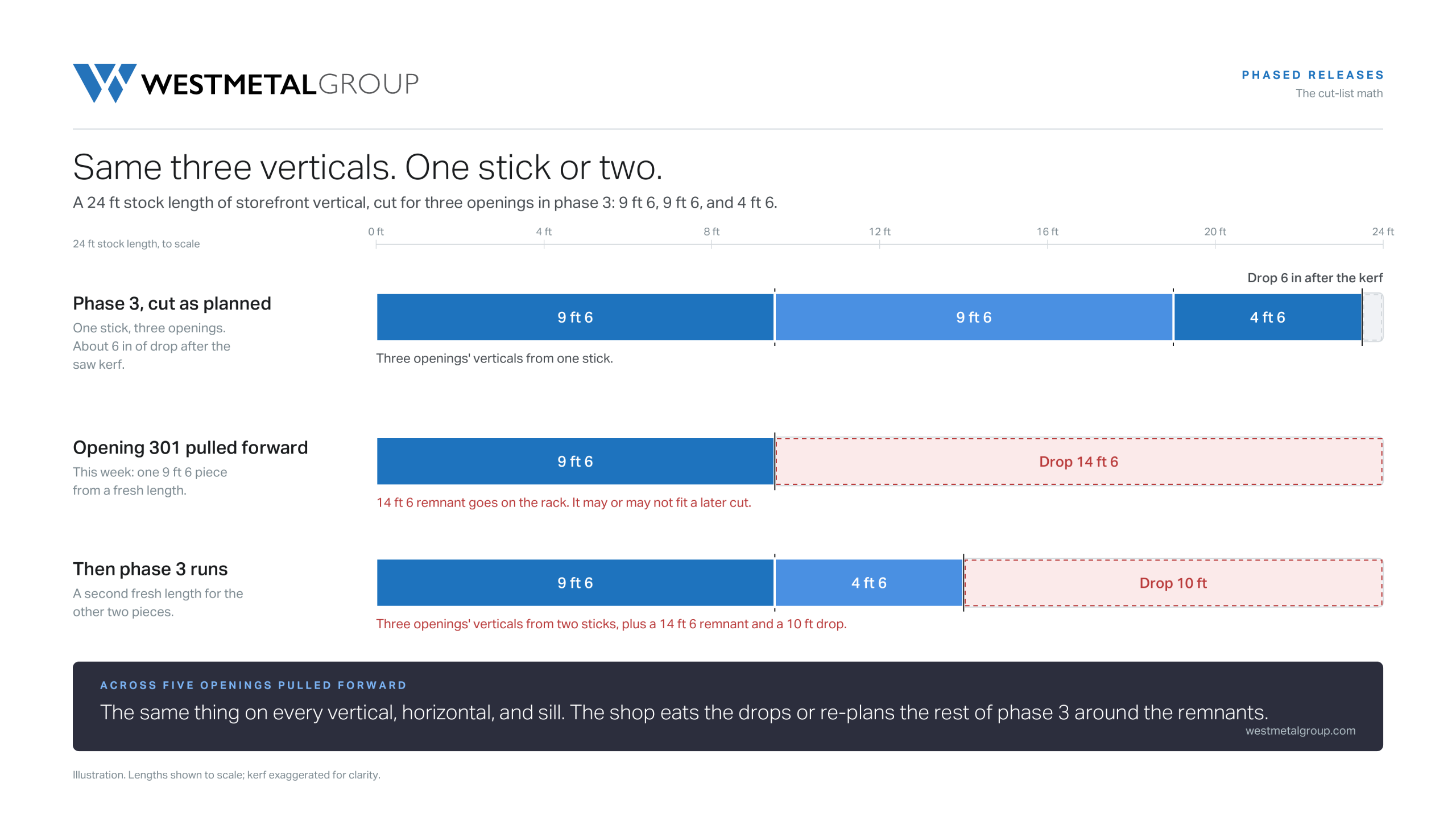
The numbers change with the system and the sizes, and a shop with good remnant tracking recovers some of it. The point does not change: pulling pieces out of a planned phase costs material and planning time that the five openings themselves do not show.
What a priority change touches, in order
- Cutting. The nested cut list for the phase is wrong. The shop either cuts the pulled pieces from fresh stock, which creates drops, or re-nests the whole phase, which is planning time before anything is cut.
- Machining. Hardware preps, notches, and weeps are run in batches by type, not by opening. Pulling five openings means setting up the machine for a handful of pieces, then setting it up again when the phase runs.
- Assembly. Frames are assembled in the order they will ship. Five frames from phase 3 go to the bench ahead of phase 2 frames that were already in line, and phase 2 slides.
- Staging. Phase material is staged together, by elevation, so it loads as one shipment. The pulled frames need their own space and their own tags, and the phase 3 pallet now has holes in it.
- Packaging. The bundling plan (by opening, by elevation, by phase) was written for the original release. A partial pull is a new bundle with a new tag and a new line on the packing list, and somebody in the field has to know that 301 through 305 arrived on the phase 1 truck.
None of that is the shop being difficult. It is what fabrication scheduling looks like from the inside, and the PM who sees it can make the change cost less.
Establish priority before fabrication begins
The cheapest priority change is the one made before the cut list exists. If there is any chance the courtyard entrance moves up, say so on the release: “Phase 3; openings 301 through 305 may be pulled to phase 1, confirm by the 15th.” The shop can nest around that, stage those five frames separately from the start, and hold their hardware. A phase defined as a set of openings with a date and a note about what might move is a plan the shop can build to. A phase that changes by phone call after the stock is cut is not.
When the change is real, communicate it early and ask the question
Sometimes the GC moves and the PM cannot stop it. The move that keeps it cheap is to tell the shop the day you know, not the day you need the frames, and to ask one question: what will this change do to the schedule for the rest of the phase, and for the other phases behind it? The shop lead can answer that in an hour if he is asked before the saw runs and in a day of re-planning if he is asked after. Then put the change on a revised release, with the new phase definitions and dates, so the cover sheet and the tags match what the field will receive. The article on how material arrives covers the bundling and tagging side; the capacity planning article covers why the shop’s queue is the schedule.
The takeaway
Changing fabrication priorities has a production cost, so communicate phases clearly and make priority changes as early and deliberately as possible. Define each phase by its openings and its date, flag what might move before the cut list is built, and when a change is real, tell the shop the day you know and ask what it does to the rest of the schedule.
WestMetal Fabrication plans each phase of a release as one run, cut list through packaging, and tells the contractor what a priority change will do to the phase and to the phases behind it before cutting around it. See what WestMetal fabricates.
Learn the fundamentals on LearnGlazing
Two free LearnGlazing courses cover the ground this article skips. Introduction to Fabrication walks through shop operations and delivery considerations, and Different Levels of Fabrication and Assembly explains knocked-down, shop-assembled, and pre-glazed packaging. WestMetal Group is a LearnGlazing partner through the GlazierIQ network. Browse the full course catalog.
Bob Baumann
Sales, WestMetal Group
I have been on the fabrication side of glazing for a long time, and before WestMetal I ran a shop floor where the release was the thing that decided whether the week went well or badly. I still read every package that comes in before it goes to the saw, and I still call the PM when something on it does not add up. WestMetal Group is part of the GlazierIQ network with MP Drafting and LearnGlazing. Questions about an article or a package? Send it to Bob.
</div >