
September 2026 · About 5 minutes
The submittal came back stamped no exceptions taken, or approved as noted, and the new PM did the natural thing: forwarded it to the shop with “released” in the subject line. Three weeks later the frames are built to a wall that does not exist.
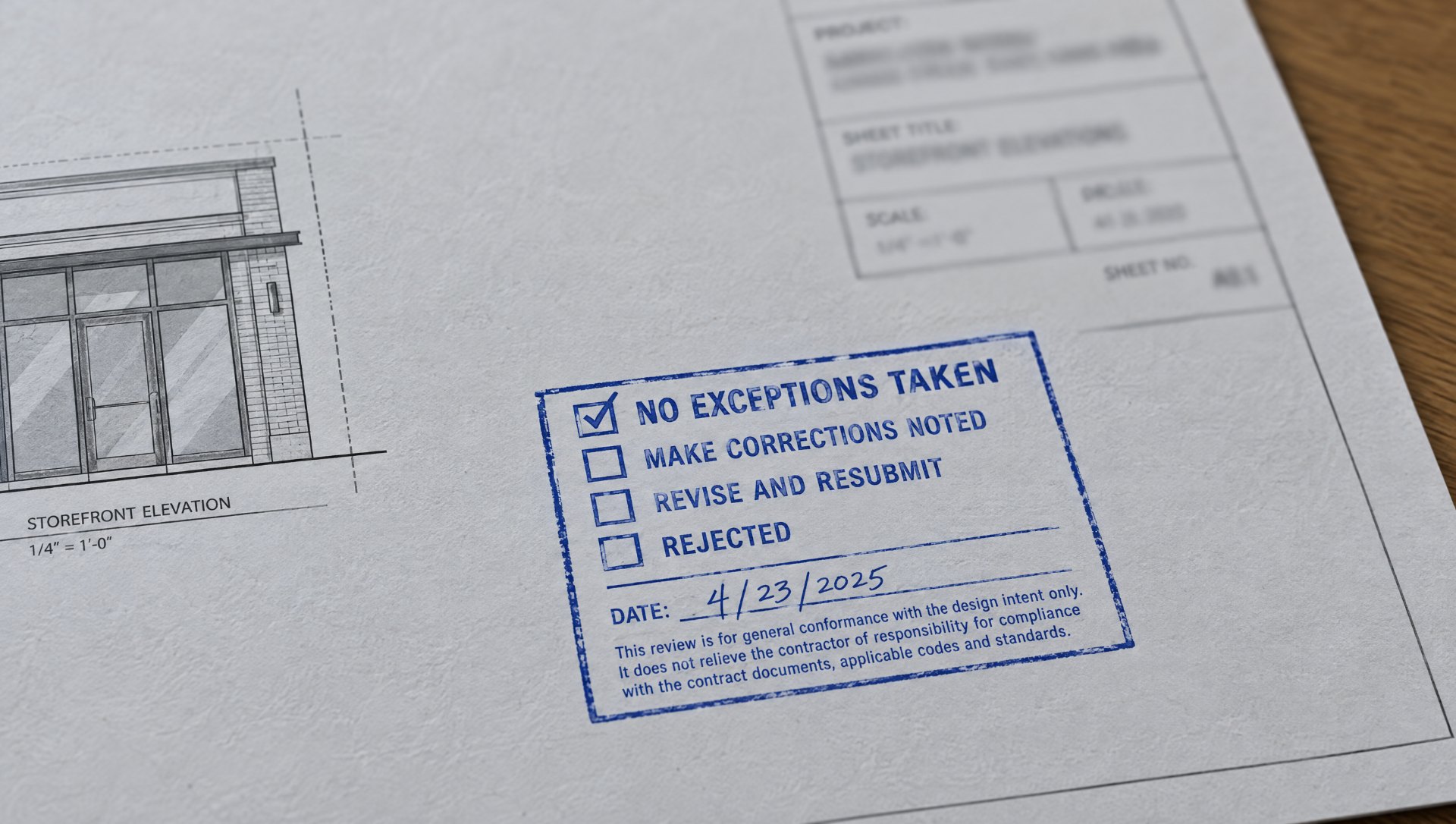
Here is what that stamp is and is not.
What “No Exceptions Taken” Actually Says
Read the fine print under any architect’s review stamp and it says roughly the same thing: the review is for general conformance with the design intent only. It does not check dimensions. It does not confirm quantities. It does not verify field conditions, fabrication processes, or coordination with other trades. The AIA’s own general conditions, A201 Section 3.12, put it in writing: the architect’s approval does not relieve the contractor of responsibility for errors in the shop drawings.
So the stamp that feels like the finish line is an architect saying, “this looks like the building I drew.” That is all it is. It is a real milestone. It is not a fabrication release.
The variants matter a little and not much. No exceptions taken means the architect had nothing to add. Approved as noted (or make corrections noted) means the architect marked things up and you are expected to build with those marks incorporated, no resubmittal. Revise and resubmit means you are not done. On most glazing jobs the first two show up about equally, and both of them leave the same list of open items sitting on the PM’s desk.
Approved Submittal vs. Fabrication-Ready Package
An approved submittal is a drawing set the architect agrees with. A fabrication-ready package is a drawing set the shop can build from without asking a question or making a guess. Those are different documents, and the distance between them is where remakes come from.
The shop drawings were probably drawn from the architectural set and a site visit that happened months ago. Since then, the block wall went up a half inch fat, the hardware supplier substituted a closer, the owner changed the finish on the entrances, and there is an RFI about the sill flashing that nobody has answered. The stamp does not know about any of that. The stamp was looking at sightlines.
Four Things to Close Before You Hit Release
Field dimensions and site conditions. The single most expensive assumption in glazing is that the opening is what the drawings say it is. Send someone to measure the openings that exist, and for the ones that do not exist yet, get the framer or mason to commit to a dimension in writing. If a head condition changed because the structure changed, the shop drawing is wrong no matter how many stamps are on it.
Latest revision, hardware, finish, and quantities. Pull the current architectural revision and compare it to the one the shop drawings were made from. Then the hardware: the schedule in the submittal was correct on the day it went out, and hardware changes more than anything else on a job. Then finish, because “clear anodized” and “clear anodized, Class I” are two different POs. Then count the openings on the schedule against the elevations. A package with the wrong quantity is not partly right.
Open RFIs, substitutions, and electrical. Any RFI that touches an opening has to be closed before that opening is released, and “we assume it will come back the way we asked” is not closed. Substitutions have to be reflected on the drawings, not just in an email chain. And if any door on the job has a card reader, an electric strike, or a powered exit device, the wiring path has to be resolved now, while the aluminum is still bare. (There is a whole article on that one.)
Coordination with the trades around you. The wall, the ceiling, the flooring at the threshold, the roofer at the head flashing, the electrician above the header. The stamp did not check any of them. You do.
The One Question
Teach a new PM one thing and make it this. Before releasing anything, ask: can the fabricator build this package without guessing?
Not “is it approved.” Not “is it mostly done.” Can the shop pick up these drawings, cut every piece, prep every door, and pack it by opening without emailing you a question. If the answer is no, then the package is not released, it is being drafted, and you are the one still drafting it.
That question also tells you what to send. A release is the stamped drawings plus everything the stamp did not cover: verified dimensions, the current hardware schedule, the finish confirmation, the closed RFIs, and a cover sheet that says which openings, which phase, and when the field needs them.
What the Shop Does With a Guess
A fabricator who gets an ambiguous package has two choices. Stop and ask, which costs you days on the schedule. Or guess, which costs you a remake if the guess is wrong. Neither one is the shop’s fault. Both of them look like the shop’s fault from the field.
Here is the takeaway. Keep a one-line log per opening: stamp date, field dimension confirmed (date, by whom), hardware rev, finish, open RFIs, release date. If any column is blank, the opening does not go. It takes ten minutes a day and it ends the argument about who released what.
A Release the Shop Can Build From
WestMetal fabricates storefront, curtain wall, and entrance packages from the release you send, and the first thing we do is read it the way a fabricator does: looking for the guess. If the package is complete, we cut. If it is not, we tell you exactly what is missing before anything is cut. Send us the stamped set and the hardware schedule and we will tell you whether it is ready.
Learn the fundamentals on LearnGlazing
The gap between an approved submittal and a fabrication-ready package is the subject of three short LearnGlazing courses. Send a new PM through these before the next release.
- Submittal & Approval Process the submittal workflow, logs, and what each stamp means.
- Don’t Skip the Shop Drawing Review how to review a set the way the shop will read it.
- Shop Drawing Liability who owns an error after the stamp, and why the stamp does not move it.
WestMetal Group is a LearnGlazing partner through the GlazierIQ network. Browse the full course catalog.
Bob Baumann
Sales, WestMetal Group
I have been on the fabrication side of glazing for a long time, and before WestMetal I ran a shop floor where the release was the thing that decided whether the week went well or badly. I still read every package that comes in before it goes to the saw, and I still call the PM when something on it does not add up. WestMetal Group is part of the GlazierIQ network with MP Drafting and LearnGlazing. Questions about an article or a package? Send it to Bob.